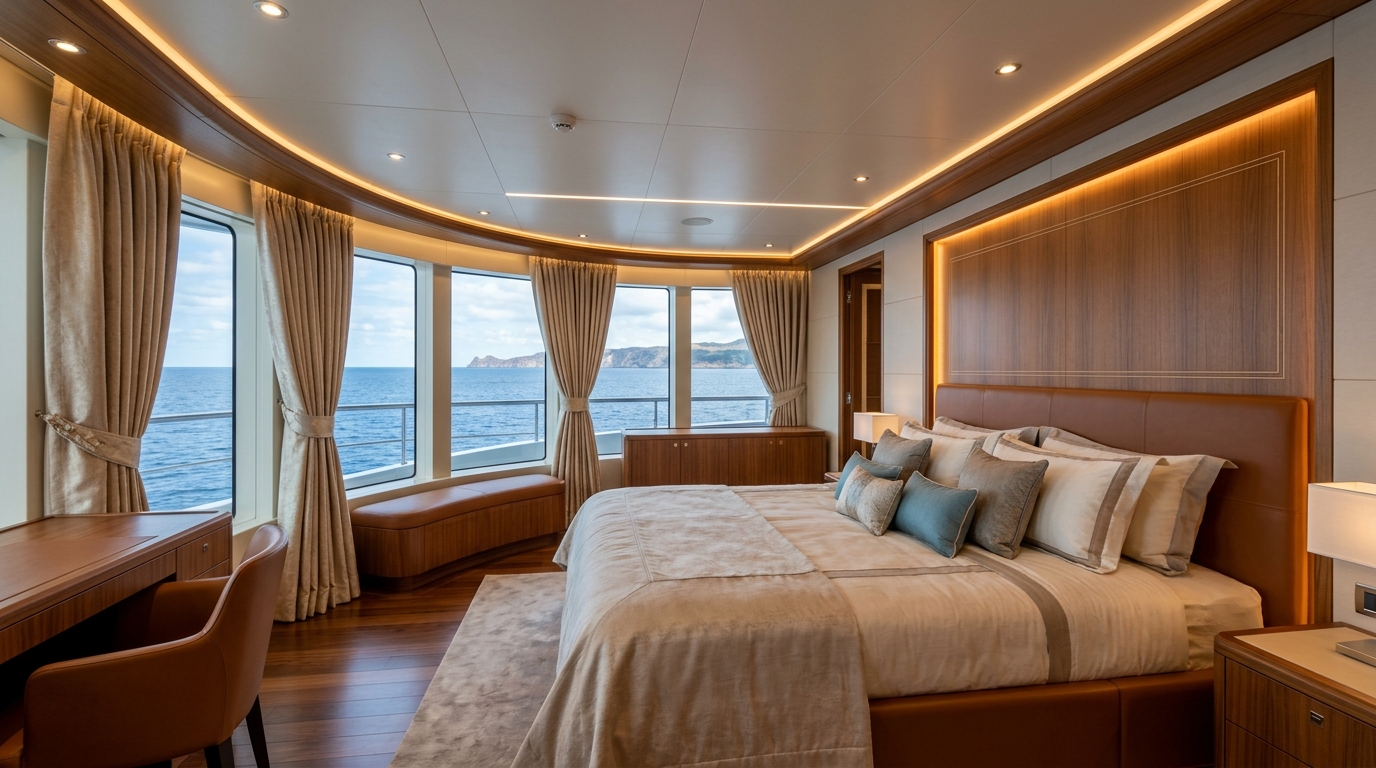
Uncompromising Safety at High Seas: The Importance of IMO and MED Certified Fire-Retardant Marine Mattresses
In the maritime industry, whether in newbuilding or refit projects, fire safety stands at the top of critical compliance regulations. Under SOLAS (Safety of Life at Sea) standards, accommodation equipment installed on commercial vessels, offshore platforms, and passenger ships must pass stringent testing protocols.
⚠️ Critical Notice: Statistically, crew cabins are among the areas where shipboard fires most frequently originate and spread most rapidly. Utilizing standard home or hotel mattresses on vessels is classified as a direct non-compliance, leading to potential ship detention during Port State Control (PSC) inspections and classification audits.
Equipped with Directive 2014/90/EU (MED) and IMO 2010 FTP Code Part 9 standards, fire-retardant marine mattresses are not merely a legal requirement; they are a critical safety barrier for crew and passenger survival. At Deha Marine, we supply full-compliance marine mattress solutions meeting these global marine safety standards.
Why Are IMO 2010 FTP Code Part 9 and MED (Wheelmark) Standards Mandatory?
During shipyard outfitting, mattresses and bedding components must not propagate flames, emit high toxicity levels, or melt into burning droplets during a fire outbreak. These requirements are guaranteed by two primary certifications:
- IMO 2010 FTP Code Part 9 (Test for Bedding Components): This testing regime exposes the mattress to smouldering cigarette and open flame ignition sources. The mattress must resist ignition or exhibit self-extinguishing properties upon removal of the flame source.
- MED (Marine Equipment Directive) Module B and D Approval: Verifies that the product is not merely a lab-tested prototype, but that the entire production facility, CMHR foam, fire-retardant covers, and sub-layers operate under an audited continuous quality management system.
A mattress stamped with the Wheelmark symbol confirms to marine surveyors that the product fully meets the rigorous safety requirements for international voyages.
Anatomy of a True Marine Mattress: Engineering Differences
Distinguishing a certified fire-retardant mattress from a standard mattress requires examining its layered engineering:
- CMHR Foam and Fire Barrier Layers
The primary hazard in cabin spaces is the flammable nature of standard polyurethane foam. The Deha Marine mattress range utilizes CMHR (Combustion Modified High Resilience) foam. Specialized fire-retardant marine fibers, interliners, and felt layers smother flames before they reach the inner core.
(Image Placement 1 – Alt Tag: CMHR fire retardant foam layer structure marine mattress)
- Vibration Resistance and Marine Environment Durability
Continuous engine room vibrations accelerate structural collapse in standard residential mattresses. Marine mattresses feature reinforced spring/core architecture and high-density foam designed for high-vibration environments. Additionally, anti-bacterial, breathable FR (Flame Retardant) outer fabrics prevent mold and mildew caused by humid sea air.
- Custom-Fit Cabin Tailoring
Ship cabins rarely adhere to standard domestic dimensions. For curved hull geometry, officer bunks, or integrated storage beds, mattresses must be manufactured with millimeter accuracy according to custom-fit technical drawings.
Comparison: Standard Hotel Mattress vs. IMO/MED Certified Marine Mattress
| Parameter | Standard Mattress (Home/Hotel) | Deha Marine IMO/MED Approved Mattress |
|---|---|---|
| Fire Behavior | Rapid ignition, toxic smoke, and flaming droplets | Non-ignitable, self-extinguishing |
| Core Material | Standard polyurethane foam and polyester | Fire-retardant CMHR foam, FR protective barriers |
| Class & PSC Audits | Non-compliant; causes port detention | Approved by all major IACS classification societies |
| Vibration Resistance | Core collapses quickly under machinery vibration | Structural stability under heavy vibration |
Operational Efficiency: Vacuum-Packed Packaging Technology
Transporting bulky mattresses through narrow companionways, steep stairs, and tight scuttles creates labor bottlenecks at shipyards. Deha Marine mattresses utilize vacuum-packed roll packaging technology. Mattresses are compressed, rolled, and easily maneuvered into cabins, expanding to their certified dimensions within minutes of unsealing.
(Image Placement 2 – Alt Tag: Vacuum packed roll packaging marine mattress for ship outfitting)
Frequently Asked Questions (FAQ)
Is Wheelmark (MED) certification mandatory for ship mattresses?
Yes. Vessels flying EU flags or operating in international waters must carry MED (2014/90/EU) Wheelmark certified bedding equipment in accommodation spaces under SOLAS guidelines.
Can standard hotel mattresses be used on commercial ships?
No. Standard hotel mattresses fail IMO 2010 FTP Code Part 9 flammability tests. Detection during Port State Control (PSC) inspections results in deficiency notices or vessel detention.
Does Deha Marine supply custom-shaped marine mattresses?
Yes. Deha Marine provides custom-fit, tailored IMO/MED certified marine mattresses built to exact technical specifications and unique cabin dimensions.
Conclusion & Contact
IMO 2010 FTP Code Part 9 and MED Wheelmark certified fire-retardant marine mattresses are essential outfitting assets that safeguard life, ensure regulatory compliance, and protect operational continuity at sea.