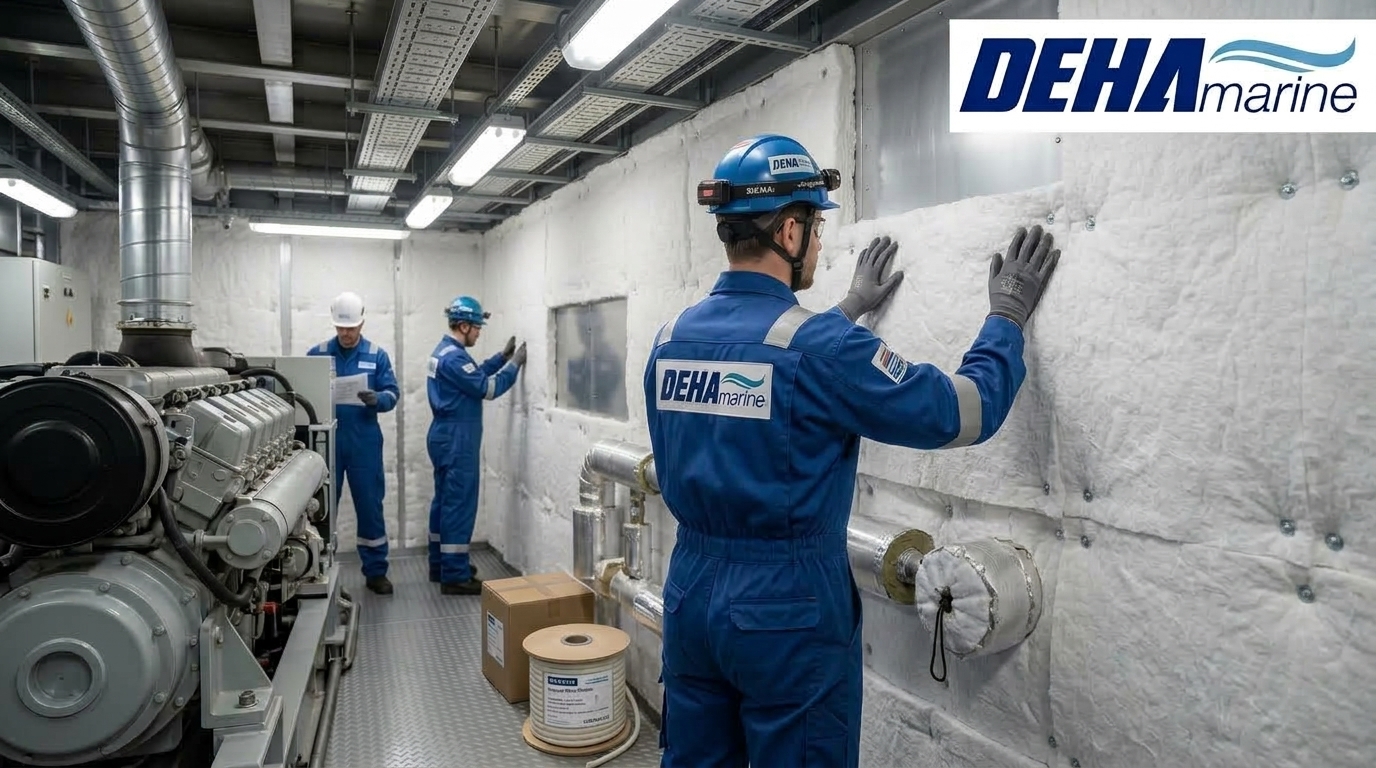
High-Temperature Ceramic Fiber Insulation Guide: Technical Features, Types, and Marine Applications
Managing thermal efficiency, reducing energy loss, and guaranteeing fire safety in high-temperature industrial processes and shipbuilding are among the most critical engineering requirements. Traditional insulation materials fail to withstand extreme thermal exposure in environments ranging from industrial furnaces and engine rooms to exhaust lines and A-Class fire divisions. This is where Ceramic Fiber Blankets and innovative Biosoluble AES Fiber Insulation Blankets become essential.
This technical guide provides an in-depth review of ceramic fiber properties, working principles, biosoluble fiber technology, and key criteria for selecting the proper insulation material.
- What is Ceramic Fiber and How Does It Work?
Ceramic fiber is a flexible, lightweight, and highly refractory insulation material manufactured by spinning or blowing high-purity molten minerals, predominantly alumina (Al2O3) and silica (SiO2).
Key Properties of Ceramic Fiber Blankets:
- Exceptional Thermal Insulation: Low thermal conductivity (W/mK) minimizes heat transfer from extreme high-temperature surfaces.
- Low Heat Storage: Porous, lightweight fibrous structure stores minimal heat, allowing rapid heating and cooling cycles that maximize energy efficiency in furnace and process operations.
- Thermal Shock Resistance: Resists cracking or structural failure during drastic thermal fluctuations (from ambient up to temperatures exceeding 1000C).
- Flexibility and Ease of Installation: Blanket form allows seamless wrapping around pipes, curved surfaces, and complex machinery geometries.
- Types of Ceramic Fiber and Fiber Technologies
Fibrous insulation blankets utilized in industrial and maritime applications fall into two primary categories:
- Standard Refractory Ceramic Fiber Blankets (RCF)
Typically rated for classification temperatures of 1260C to 1400C, RCF blankets are engineered for extreme heat environments and heavy industrial furnace linings. They offer superior dimensional stability and low linear shrinkage.
- Biosoluble Fiber Blankets (AES – Alkaline Earth Silicate)
Developed as a health-safe alternative to traditional ceramic fibers, AES (Calcium-Magnesium-Silicate) blankets prioritize occupational health and safety (OH&S) standards. If inhaled, biosoluble fibers clear rapidly from human lung tissue via biological body fluids, preventing pulmonary persistence.
- Two Critical Quality Parameters: Needling and Binder Structure
The performance and durability of a ceramic or biosoluble blanket depend heavily on manufacturing precision:
- Double-Sided Needling Technology: Fibers are mechanically cross-locked from both sides during production. High-density double-sided needling prevents edge delamination during cutting and retains structural integrity under severe vessel vibration during sea passages.
- 100% Binder-Free Composition: Blankets produced without organic or chemical binders emit zero smoke, toxic gas, or unpleasant odors upon initial heating. This ensures clean air quality and preserves visibility in enclosed spaces and crew quarters during high-heat operation or fire emergencies.
- Key Application Areas in Marine & Industry
Refractory and biosoluble blankets cover a wide range of demanding applications:
- Shipbuilding & Marine: Engine room insulation, main/auxiliary exhaust systems, marine boiler insulation, steam/gas turbines, and SOLAS ‘A’ Class Fire Divisions.
- Industrial Furnaces: Roof and wall linings for ceramic, brick, cement, and glass kilns.
- Energy & Petrochemical: Chemical process heaters, reformers, high-temperature pipelines, and fire protection for cryogenic vessels.
- Engineering-Grade Certified Solutions: DEHA Marine D-Wool Series
Engineered to fulfill strict IMO/SOLAS fire safety standards and rigorous occupational health regulations, the DEHA Marine D-Wool product family delivers advanced insulation technology backed by international certifications.
DEHA Marine provides two specialized solutions:
🟢 D-Wool CFBB 1000: Biosoluble (AES) Fire & Thermal Blanket
- Health & Safety Certified: Certified by Germany’s Fraunhofer Institute (Study No: 02G24002) in full compliance with EU CLP Regulation EC No 1272/2008 for safe human biosolubility.
- Temperature Rating: 1100C classification temperature, 1000C continuous use.
- Marine Certification: MED (Wheelmark) Module B and Module D certified via MIRTEC / EBETAM (0437); fully compliant with IMO Res. MSC.307(88) 2010 FTP Code Part 1.
🔵 D-Wool CFB 1260: High-Performance Ceramic Fiber Blanket
- Extreme Heat Resistance: 1260C classification temperature, 1200C continuous use.
- High Thermal Stability: Exhibits minimal linear shrinkage (≤3.0% after 24 hours at 1200C).
- Binder-Free & Resilient: 100% organic binder-free, double-sided needled for high tensile strength (≥0.03-0.075 MPa). Fully certified under MED Module B and Module D.
Technical Comparison Matrix
| Parameter / Property | D-Wool CFBB 1000 JPG | D-Wool CFB 1260 |
|---|---|---|
| Classification Temperature | 1100C | 1260C |
| Continuous Operating Temp. | 1000C | 1200C |
| Structure / Fiber Type | Biosoluble AES Fiber | Standard Refractory Ceramic Fiber |
| Health & Safety (OH&S) | Fraunhofer Certified (Non-persistent) | Standard PPE Required |
| Linear Shrinkage (24 hrs) | ≤3.0% at 1000C | ≤3.0% at 1200C |
| Tensile Strength (MPa) | 0.03-0.075 MPa (64-160 kg/m3) | 0.03-0.075 MPa (64-160 kg/m3) |
| Binder Content | 0% Organic Binder (Binder-free) | 0% Organic Binder (Binder-free) |
| MED Certification | MED Module B + Module D (Wheelmark) | MED Module B + Module D (Wheelmark) |
| IMO Fire Code Compliance | IMO Res. MSC.307(88) 2010 FTP Code Part 1 | IMO Res. MSC.307(88) 2010 FTP Code Part 1 |
The Logistics Edge: In contrast to global competitors requiring 4 to 8 weeks for delivery, DEHA Marine dispatches directly from inventory, delivering within 24 hours to Turkish shipyards (Tuzla, Yalova, Ereğli) and 3 to 7 days to European shipyards.
❓ Frequently Asked Questions (FAQ)
Q1: Is ceramic fiber hazardous to human health?
Inhalation of traditional refractory ceramic fibers (RCF) presents lung persistence concerns. Consequently, modern marine and industrial projects favor biosoluble (AES) blankets for enclosed spaces and personnel safety. For instance, D-Wool CFBB 1000 features Fraunhofer Institute-certified biosolubility, allowing fibers to clear naturally from the body without accumulating in lung tissue.
Q2: What is the primary difference between biosoluble (AES) and ceramic fiber blankets?
The primary difference lies in chemical composition and biological solubility. While standard ceramic fibers withstand higher thermal limits (1260C+), biosoluble blankets provide high thermal protection up to 1000C–1100C while guaranteeing full health safety compliance.
Q3: Which certifications are mandatory for marine insulation?
According to IMO and SOLAS rules, insulation materials installed on vessels must hold MED (Wheelmark) approval. A Type Approval (Module B) alone is insufficient; production quality assurance under Module D and IMO 2010 FTP Code Part 1 non-combustibility test reports are strictly required. The D-Wool series maintains complete certification under both Module B and Module D.
Q4: Does ceramic fiber produce smoke or odor during initial heating?
Low-grade blankets containing organic or chemical binders produce smoke and noxious fumes upon initial heating. However, 100% binder-free blankets like D-Wool CFBB 1000 and D-Wool CFB 1260 emit zero smoke, toxic gas, or odor when exposed to heat.
Q5: Does ceramic fiber blanket shrink under high temperatures?
High-quality ceramic blankets exhibit minimal shrinkage. D-Wool CFB 1260 demonstrates only 3.0% linear shrinkage after 24 hours of continuous exposure at 1200C, preventing thermal gap formation.
Q6: What is the lead time for ceramic blanket orders?
Global import brands typically require 4 to 8 weeks lead time. Leveraging our strategic inventory, DEHA Marine delivers within 24 hours to Turkish shipyards and 3 to 7 days to European ports.
📩 Technical Support & Sample Request
For project-specific calculations, official certification documentation, further technical details, and sample requests, please contact us. Our engineering team is ready to assist you in selecting the ideal D-Wool insulation solution and dispatching sample kits to your shipyard or facility.