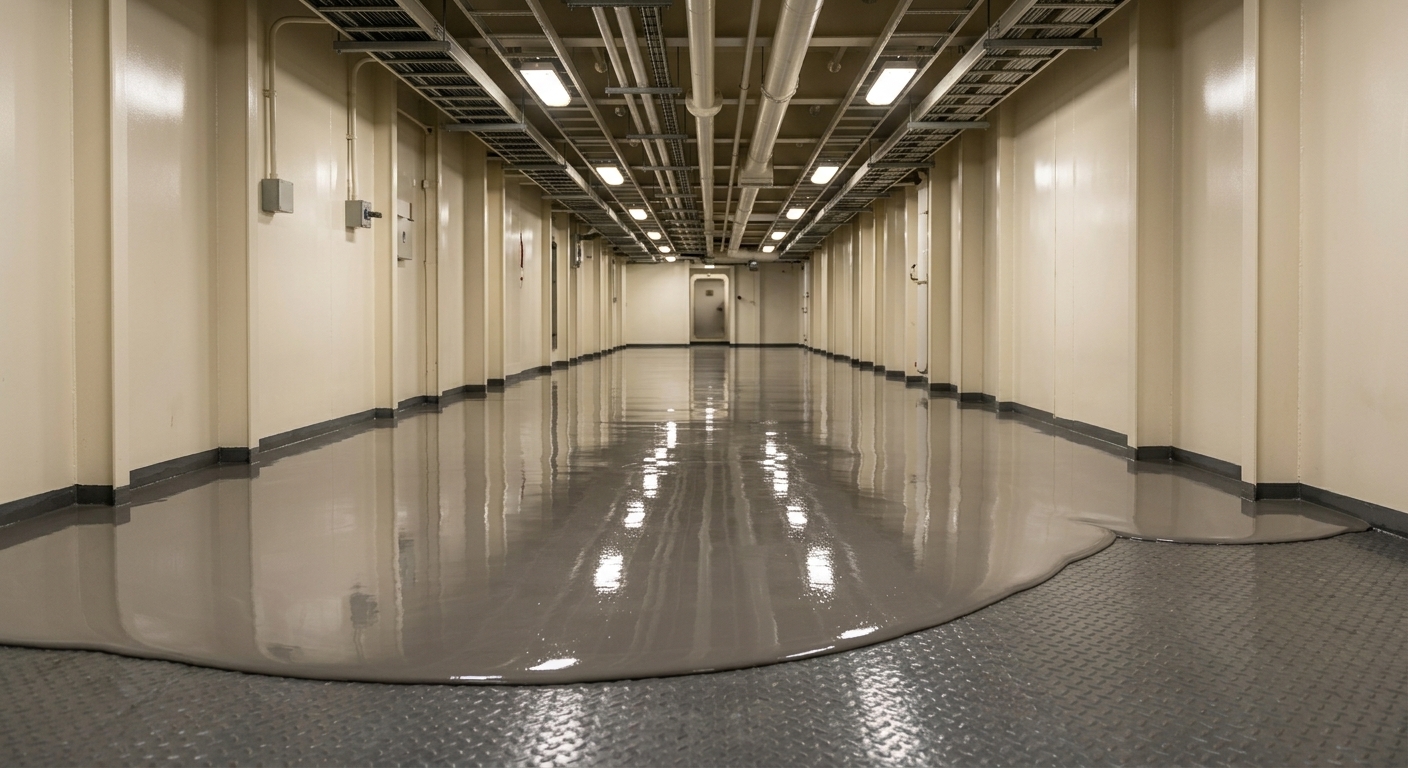
Everything You Need to Know About Marine Screeds and Deck Levelling Systems
In shipbuilding, yacht manufacturing, and offshore projects, sub-floor preparation is one of the most critical steps for long-term structural integrity and the seamless application of top-layer floor coverings (such as PVC, linoleum, carpet, rubber, or timber). Unlike land-based structures, marine vessels are continuously subjected to severe dynamic forces including seawater humidity, hull flexing, persistent vibration, and varying load distributions.
Therefore, floor levelling compounds and marine screeds (marine self-leveling / marine screed) used in the maritime industry must possess technical properties far superior to standard cementitious materials.
What Are the Key Characteristics of Marine Screed Materials?
A reliable marine screed material suitable for harsh marine environments must meet the following fundamental criteria:
- Flexibility and Vibration Resistance: It must feature a flexible binder structure that adapts to the movement of steel decks and engine vibrations without cracking.
- Lightweight Formulation (Weight Control): Every additional ton on a vessel directly affects fuel consumption and stability. Hence, marine screeds must deliver high strength while maintaining a low specific gravity.
- Versatile Application Thickness: It should accommodate varying thicknesses, from millimetric imperfections on steel plates to deep deformations and level differences.
- Fast Setting and Curing: To avoid extending dry-dock periods during shipyard repairs and maintenance, rapid strength development is essential.
- Fire Safety: It must comply with International Maritime Organization (IMO / MED) fire safety and flame-retardant standards.
Where Are Different Marine Flooring Materials Used?
Sub-floor preparation in marine applications generally addresses two primary needs:
- Self-Leveling Thin Screeds
Used to achieve smooth, self-leveling, and perfectly flat surfaces prior to installing top coverings. These are typically preferred in wheelhouses, passenger cabins, corridors, and accommodation areas. High fluidity minimizes the need for extra sanding labor.
- Fast-Curing Flexible Filling Screeds (Heavy Duty / Fast Curing Screed)
Designed for areas with significant level differences, heavy deck plate deformations, or where thick layers are required. Applied in galleys, service areas, decks above engine rooms, and deep repair zones in refit projects to level the structure without adding excessive dead weight.
High-Performance D-FLEX Solutions for Marine Flooring
To meet these distinct technical demands in your ship and yacht projects, we offer two engineered solutions designed for long-lasting performance:
D-FLEX 7040 SLX: Smooth Thin-Layer Self-Leveling Screed
- Application Thickness: Suitable for thin to medium layers ranging from 3 to 30 mm.
- Purpose: Provides smooth, perfectly level substrates under final deck coverings thanks to its high fluidity and self-leveling properties.
- Performance: Upgraded to C35 compressive strength and F7 flexural strength classes, ensuring maximum crack resistance and flexibility even in thin applications.
D-FLEX 7050 FLX: Fast-Curing Flexible Filling Screed
- Application Thickness: Designed for deep levelling and filling applications from 5 to 50 mm.
- Purpose: Rapidly levels deep distortions and plate deformations in high-volume applications without burdening the vessel structure.
- Performance: Light foot-traffic ready in approximately 3–4 hours post-application. Its C35/F7 performance class eliminates the risk of slumping, wear, or cracking in thick layers.
Both products are manufactured in full compliance with international maritime standards and hold IMO/MED certification frameworks.
Frequently Asked Questions (FAQ) About Marine Screeds
What is the difference between a marine screed and a standard construction screed?
Standard construction screeds are rigid and designed for stationary land structures. Marine screeds, on the other hand, offer high flexural strength to withstand hull flexing, vessel twisting, and wave action. They are also specially formulated to resist marine humidity and meet strict IMO fire safety standards.
How soon after application can a marine screed be walked on?
Depending on the specific formulation, fast-curing flexible filling screeds (such as D-FLEX 7050 FLX) achieve foot-traffic capability in as little as 3–4 hours. This rapid curing minimizes downtime during shipyard operations.
Can marine screed be applied directly onto raw steel decks?
Prior to application, the steel deck should be thoroughly cleaned of rust, oil, and contaminants (preferably via abrasive blasting) and treated with a suitable marine primer. The primer ensures maximum bond strength and adhesion between the metal substrate and the screed.
What is the maximum layer thickness for a single marine screed application?
Smooth self-leveling screeds are typically applied between 3 and 30 mm, whereas flexible filling and repair screeds can be safely cast in single layers from 5 up to 50 mm.
We Are Ready to Provide Technical Support for Your Projects
Selecting the right product, calculating accurate material quantities, and executing proper surface preparation are vital to the success of shipbuilding, yacht manufacturing, and refit projects. Our technical engineering team is ready to assist you in selecting the ideal marine screed system, providing complete technical documentation, and delivering on-site support at the shipyard.
Contact us today to learn more about our marine flooring solutions and to request tailored technical support for your project.